
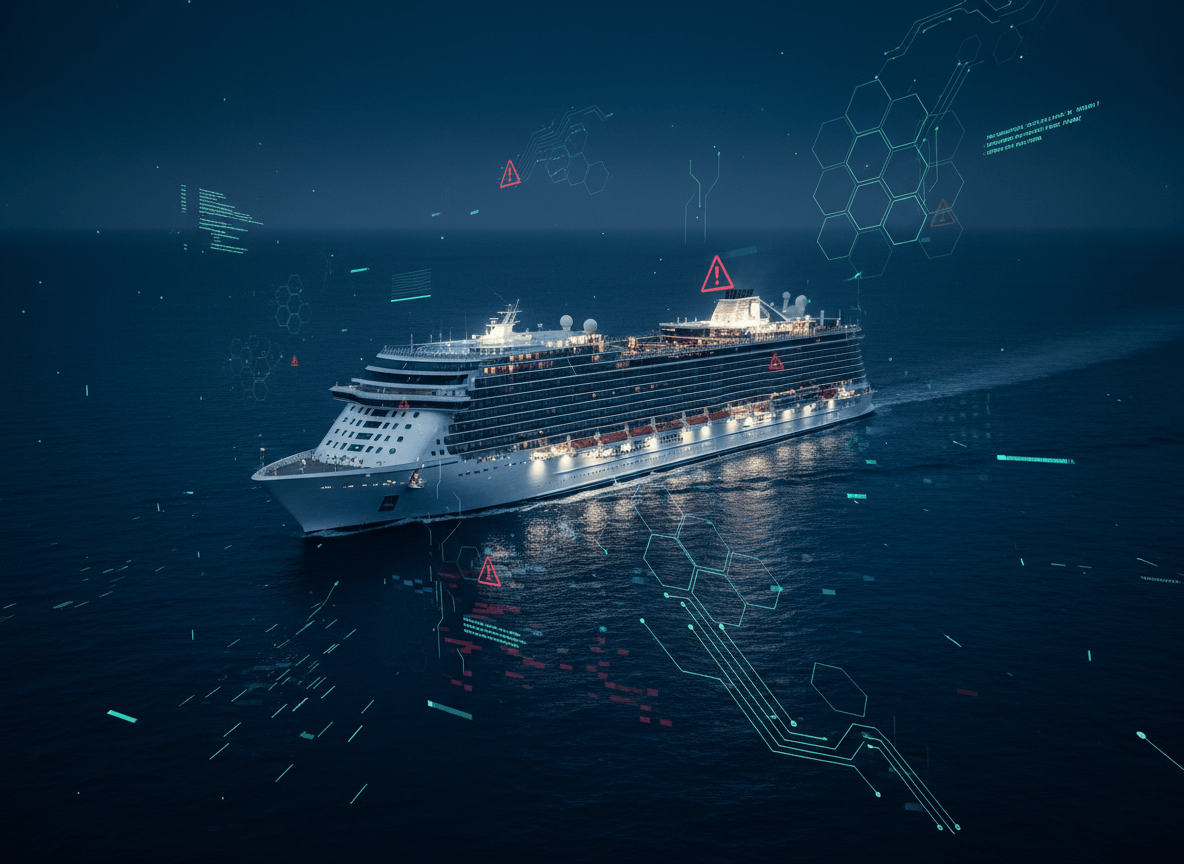
How Cruise Line Cyberattacks Expose Enterprise Security Weaknesses
High‑profile cyberattacks against cruise lines are more than headline events — they are case studies in enterprise security failure.
Global travel companies operate highly complex digital ecosystems. When breaches occur, they reveal systemic weaknesses that exist in organizations of all sizes.
The lessons apply far beyond the travel industry.
Why Cruise Lines Are Prime Targets for Cybercriminals
Cruise operators manage:
- Massive volumes of personal and financial data
- Passport and identity documentation
- Health records and testing information
- Payment processing systems
- Global remote access environments
- Third‑party vendor integrations
This makes them attractive to attackers seeking financial gain, identity theft, or ransomware payouts.
But the real issue isn’t size.
It’s complexity.
The Enterprise Weaknesses These Attacks Reveal
1. Email and Credential Vulnerabilities
Many large breaches begin with:
- Phishing campaigns
- Compromised login credentials
- Business email compromise (BEC)
- Weak multi‑factor authentication enforcement
In enterprise environments with thousands of users, even a small percentage of vulnerable accounts can create significant exposure.
Lesson: Identity security must be continuously monitored — not just implemented once.
2. Overextended IT Infrastructure
Cruise lines operate:
- On‑premise systems
- Cloud platforms
- Remote ship‑based networks
- Vendor portals
- Global office locations
This distributed environment increases the attack surface dramatically.
Most mid‑sized businesses now operate similarly — even if they don’t realize it.
Hybrid work, SaaS platforms, and remote access create comparable complexity.
Lesson: Visibility across environments is critical.
3. Vendor and Third‑Party Risk
Large travel organizations rely heavily on:
- Booking platforms
- Payment processors
- Medical providers
- Logistics vendors
- IT service providers
Every vendor connection expands the risk perimeter.
Without vendor risk assessment and monitoring, attackers often find an indirect path into enterprise systems.
Lesson: Your security is only as strong as your weakest integration.
4. Delayed Detection and Incident Response Gaps
In many enterprise breaches, unauthorized access persists for days or weeks before detection.
This allows attackers to:
- Escalate privileges
- Exfiltrate sensitive data
- Deploy ransomware
- Establish persistence mechanisms
Organizations without 24/7 monitoring often discover incidents only after significant damage occurs.
Lesson: Detection speed determines impact severity.
Why This Matters for Mid-Sized Businesses
It’s easy to assume cruise lines are targeted because of their scale.
But attackers increasingly focus on small and mid‑sized enterprises because:
- Security resources are limited
- Monitoring is inconsistent
- Incident response plans are outdated
- Backup systems are not regularly tested
The tactics used against global brands are now routinely deployed against regional businesses.
The difference is only budget — not methodology.
Common Patterns in Travel Industry Cyber Incidents
Across multiple publicly reported cruise line and travel sector breaches, recurring patterns emerge:
- Credential theft as initial access vector
- Email account compromise
- Ransomware deployment
- Data exfiltration before encryption
- Multi‑year repeated targeting
These patterns mirror what security teams see daily across industries.
How Enterprises Can Reduce Their Risk
To prevent similar weaknesses, organizations should implement:
✅ Multi-Factor Authentication Everywhere
Not just administrators — all users.
✅ Managed Detection and Response (MDR)
Continuous monitoring drastically reduces dwell time.
✅ Email Security Hardening
Advanced phishing detection and domain protection.
✅ Vendor Risk Assessments
Formal evaluation of third-party security controls.
✅ Endpoint Detection & Response (EDR)
Real-time visibility into workstation and server activity.
✅ Tested Backup and Disaster Recovery
Backups must be isolated and regularly validated.
The Bigger Takeaway
Cruise line cyberattacks are not isolated industry events.
They are warning signals.
They expose how:
- Identity systems break down
- Visibility gaps create blind spots
- Vendor relationships increase risk
- Delayed response magnifies impact
Organizations that learn from these incidents strengthen their defenses before becoming the next headline.
Are There Hidden Weaknesses in Your Environment?
Cybersecurity failures rarely begin with catastrophic events.
They start with:
- One compromised account
- One unpatched system
- One overlooked vendor integration
A proactive security assessment can identify vulnerabilities before attackers do.
If your organization has not recently evaluated its security posture, now is the time. happier IT Provides Expert Managed IT & Cybersecurity Services in British Columbia and Alberta. Book a Free Cybersecurity Assessment Today.


