
Future-Proofing Finance: Managed IT, Cybersecurity & AI for BC Financial Institutions

In British Columbia’s financial sector, managed IT, security and AI are no longer optional—they’re strategic must-haves.
Executive Summary: Why IT Now Matters to Financial Institutions in BC
The financial services industry—whether credit unions, regional banks, fintechs or wealth-management firms—is under tremendous transformation pressure. Customer expectations are digital, regulation is stringent, and cyber threats are ever-evolving. To compete and remain compliant in British Columbia (and Canada broadly), institutions must view technology not as a cost centre, but as a strategic foundation.
In 2025 and beyond, Managed IT (IT management), Cybersecurity, and AI Integration are central to financial industry resilience and growth. These elements deliver:
- Operational resilience: fewer outages, faster recovery, better customer experience.
- Data security & regulatory compliance: protecting sensitive client data and financial assets while meeting PIPA (BC), PIPEDA (Canada), PCI-DSS, and other frameworks.
- Business agility & innovation: using AI to reduce cost, personalize offerings, streamline risk, and gain competitive impact.
Over the next several thousand words we’ll explore how each of these pillars applies in the finance industry: what it looks like, common challenges, deep dive on each technology area, practical integration and a roadmap you can act on.
What Managed IT (IT Management) Looks Like for Financial Institutions
“Managed IT” in the finance context means outsourcing or partnering to ensure your IT environment (networks, endpoints, software, cloud services, backups) is reliable, secure, compliant and aligned to business strategy. Given the risk, regulatory load and competitive pressure in finance, running IT as “ad-hoc” is increasingly untenable. Research shows managed IT can deliver improved security, streamlined operations and cost predictability.
Core Managed IT Components for Finance
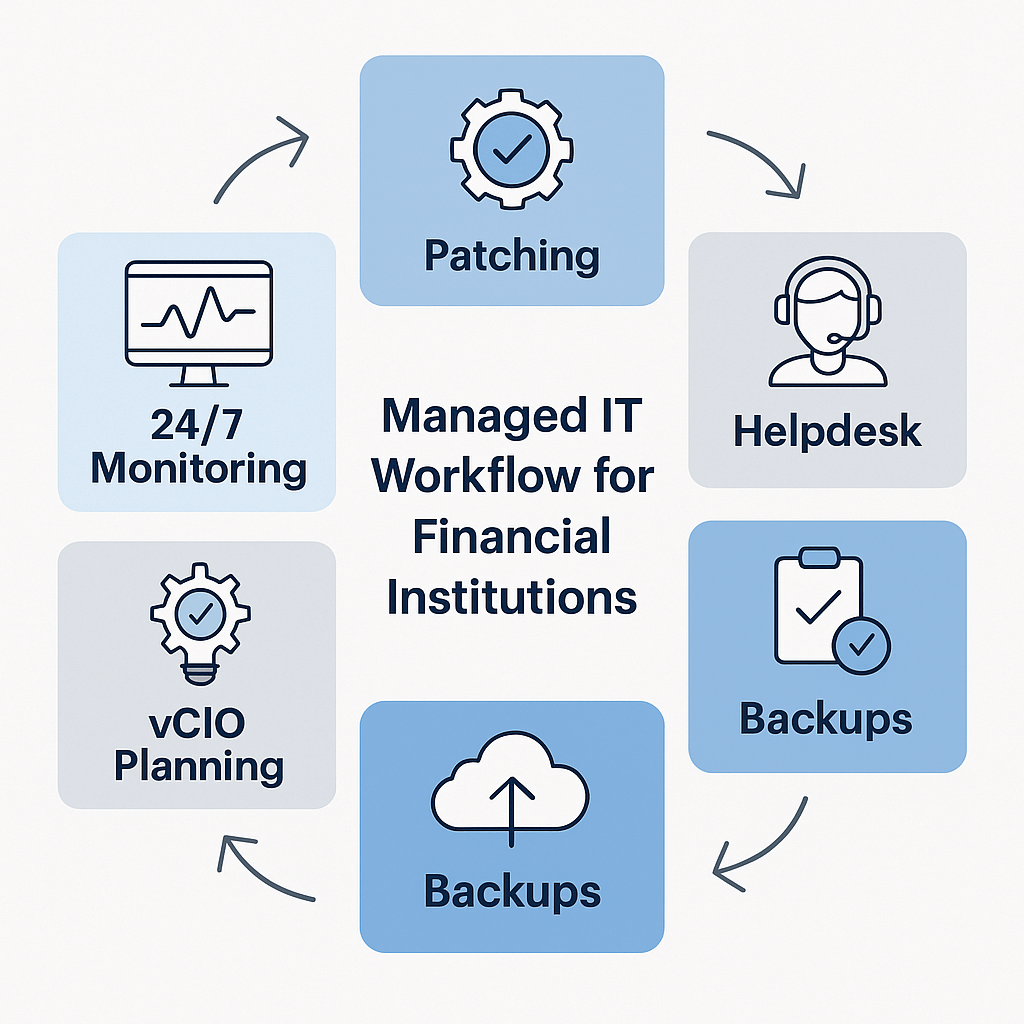
- 24/7 Monitoring & Service Desk: Continuous oversight of endpoints, networks, transactions, remote/branch operations.
- Patch & Vulnerability Management: Ensuring OS, applications, banking platforms and all third-party systems are updated, reducing exploitable legacy tech.
- Compliance & Audit-Readiness: Logging, policy management, vendor control and documentation aligned to financial regulation (BCFSA / OSFI / PCI / AML etc.).
- Disaster Recovery & Business Continuity: Financial institutions cannot afford downtime—backups, fail-over, branch redundancy, mobile capacity.
- Strategic IT Advisory (vCIO): Quarterly reviews, aligning tech spend to business objectives (member growth, digital-services expansion, regulatory uptake), and mindset shift from “IT as cost” to “IT as enabler.”
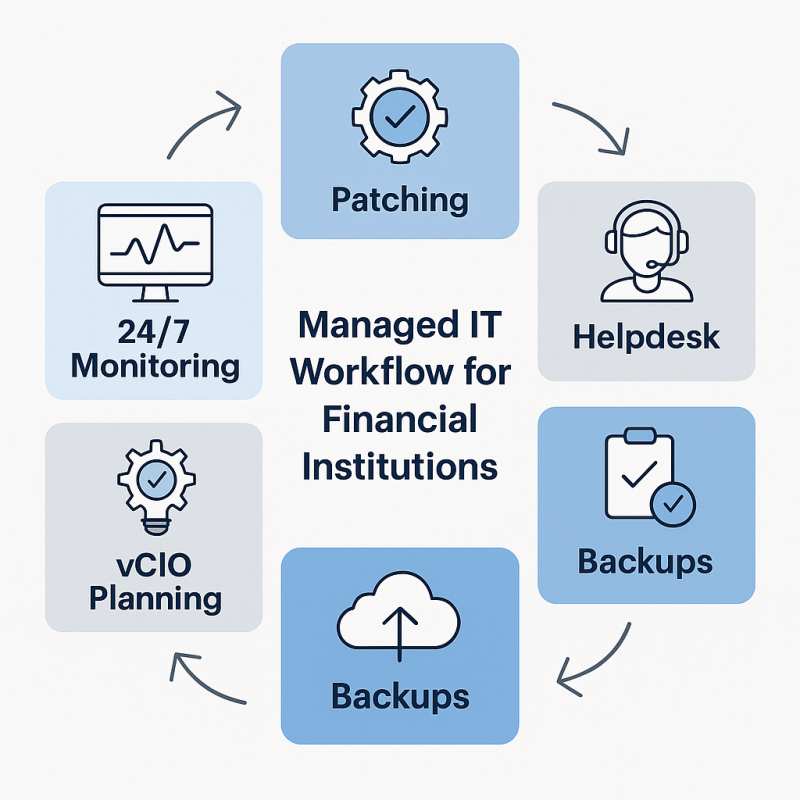
Managed IT in the financial sector requires both operational excellence and strategic alignment.
On-site, Branch & Hybrid IT Models
Financial firms must support branch offices, remote advisors, mobile users, cloud services and traditional on-premises systems. A hybrid model—with on-premises at branches + cloud + remote access + managed vendor support—is often optimal. The key: reliable connectivity, zero-trust access, secure endpoints and centralized oversight.
SLA & ROI Considerations for Finance Firms
Managed IT transitions costs from unpredictable staffing/maintenance to fixed-fee models, while delivering measurable improvements: higher availability, fewer disruptions, faster service and improved audit/or regulatory readiness. As one article notes: financial firms outsourcing managed IT can focus on core business while a specialist partner handles infrastructure, security and compliance.
Everyday IT & Infrastructure Challenges in the Financial Sector
The finance industry has unique pressures: high data volumes, heavy regulation, legacy systems, branch networks, hybrid work, third-party dependencies and real-time transactions. The following are common challenges.
Legacy Systems & Integration Debt
Many financial institutions still operate older core banking systems, messaging systems, or siloed applications. These legacy systems increase costs, slow agility, hamper integration and raise risk. As one source states: “legacy technology can lead to problems even if it still supports operations.”
Branch & Connectivity Resilience
Branches, ATM networks, mobile advisors rely on connectivity, network segmentation, secure Wi-Fi, remote access and fail-over. Outages or slow performance severely impact client experience and trust.
Data Silos & Fragmented Architecture
Core banking, CRM, payments, risk systems, analytics often run in disconnected silos—manual reconciliations, operational inefficiencies, increased risk of error and data leakage.
Talent & Cost Pressures
Smaller financial firms or credit unions may lack large IT/security teams yet must meet the same regulatory and security demands as large banks. Having a partner and efficient systems is essential.
Cybersecurity in Finance: Protecting Member/Client Data, Financial Assets & Institutional Reputation
Cyber risk in finance is existential. A breach may mean huge regulatory fines, data loss, client mistrust, operational disruption and reputational damage. Recent studies indicate that financial institutions are increasingly targeted, particularly with emerging AI/ML-powered attacks.
Why Financial Institutions Are Frequent Targets
- High-value data (personal, account, payment, trading) which attracts advanced attacks.
- Complex vendor ecosystems and third-party services, increasing attack surfaces and supply-chain risk.
- Real-time transactions and always-on services—downtime or interruption is costly and visible.
Common & Emerging Attack Vectors
- Phishing & Business Email Compromise (BEC): Spear-phishing to gain credentials or initiate fraudulent payments.
- Ransomware / Data Encryption: Threat actors target backups, operations and client data.
- Advanced Fraud via AI/Deepfakes: AI-enabled attacks create synthetic identities, impersonate executives, automate social engineering.
- Third-Party / Vendor Breaches: Outsourced services with privileged access expose risk if controls are lax.
- Insider Threats & Misconfiguration: Unpatched systems, weak access controls, misconfigured cloud services.
Practical Defence Frameworks for Finance Sector
- Identity & Access Management (IAM): MFA everywhere, least-privilege access, privileged account monitoring, session termination controls.
- Endpoint Detection & Response (EDR): Monitor endpoints, branch devices, mobile apps for anomalies and rapid remediation.
- Email & Web Security: Phishing simulation, sandboxing, link rewriting, DMARC/SPF/DKIM controls.
- Network Segmentation & Zero-Trust Architecture: Branch vs corporate vs vendor networks; restrict lateral movement.
- Immutable Backups & Business Continuity: Secure backups, regular drills, branch fail-over, high-availability systems, audited recovery.
- Vendor Risk Management: Inventory, reviews, contract clauses for breach notification, audit rights, security attestation (SOC2, ISO27001).
- Security Awareness & Culture: Ongoing training, phishing simulations, incident reporting culture, leadership engagement.
- Incident Response & Threat Intelligence: Defined playbooks for ransomware, BEC, vendor breach; integrate AI/analytics for proactive detection.
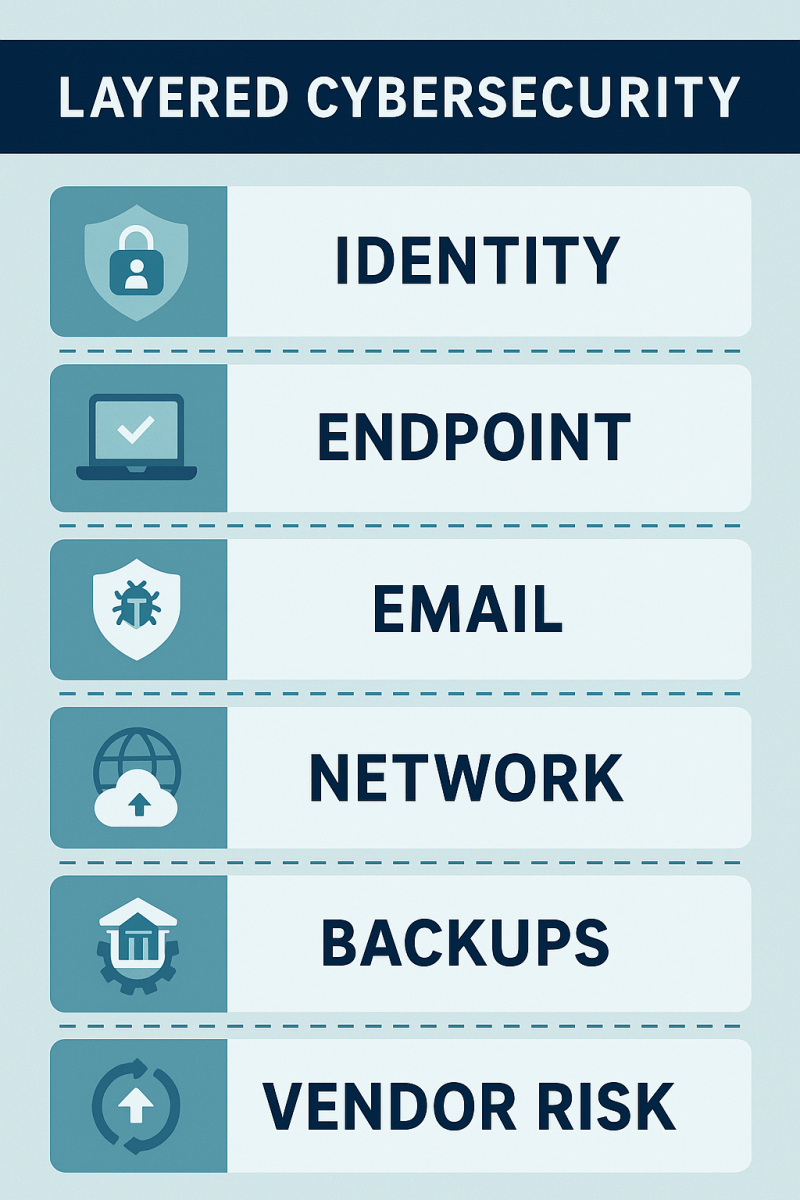
Layered cybersecurity architecture—each ring strengthens resilience and reduces risk.
Technology Integration in Finance: Making Systems Talk & Enabling Data-Driven Decisions
Integration of systems—core banking, CRM, payments, analytics, risk, vendor/third-party systems—is increasingly mandatory if you want to deliver seamless service, reduce risk, and leverage data. As one source notes: “Information technology enables digital banking, enhances operational efficiency, strengthens cybersecurity and supports data-driven decision-making in the financial services sector.”
Key Integration Themes for Financial Institutions
- Core Banking ↔ CRM & Omni-Channel Systems: Unified view of members/clients across mobile, branch, digital; single profile; fewer reconciliation errors.
- Payments / FinTech Platforms ↔ Risk/Analytics Engines: Real-time fraud detection, AML screening, transaction analysis feeding dashboards and alerts.
- Vendor / Third-Party Platforms ↔ Compliance/Monitoring Tools: Automated auditing, vendor access control, data-flows mapping.
- Analytics & AI Platforms: Integrate data from all systems to derive insight: churn risk, credit risk, cross-sell/upsell, operational inefficiencies.
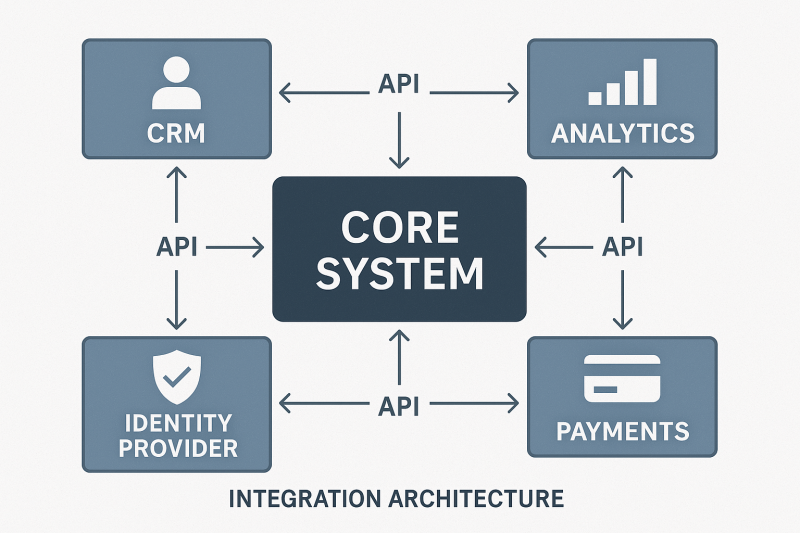
An integrated architecture enables secure, real-time data flow and insights across the organization.
AI Integration in Finance: Turning Data into Intelligence
AI isn’t just a buzzword—it’s actively reshaping the finance industry. From fraud detection to personalized service, AI is delivering measurable value.
High-Impact Use Cases for Finance
- Fraud Detection & AML Pattern Recognition: AI/ML models detect anomalies in transaction flows, money-laundering networks, suspicious account behaviour.
- Credit Risk & Underwriting: Machine learning models evaluate non-traditional data (behavioural, social, transactional) to assess creditworthiness and include underserved segments.
- Member / Client Engagement & Personalization: Chatbots, virtual assistants, predictive cross-sell/upsell, tailored service offers based on data-driven insight.
- Operational Automation & Cost Reduction: Document processing (loan apps, compliance), back-office automation, predictive maintenance for IT/infrastructure.
- Risk Forecasting & Compliance Analytics: AI monitors risk exposures, vendor policies, model bias/fairness, regulatory change impact.
Balancing Innovation & Risk
As one report shows: the rapid pace of AI adoption in finance has introduced risks—model opacity, data bias, over-reliance, vendor concentration and unintended vulnerabilities. Therefore, finance institutions must implement AI governance, human-in-the-loop controls, explainability, audit trails and vendor review as part of deployment.
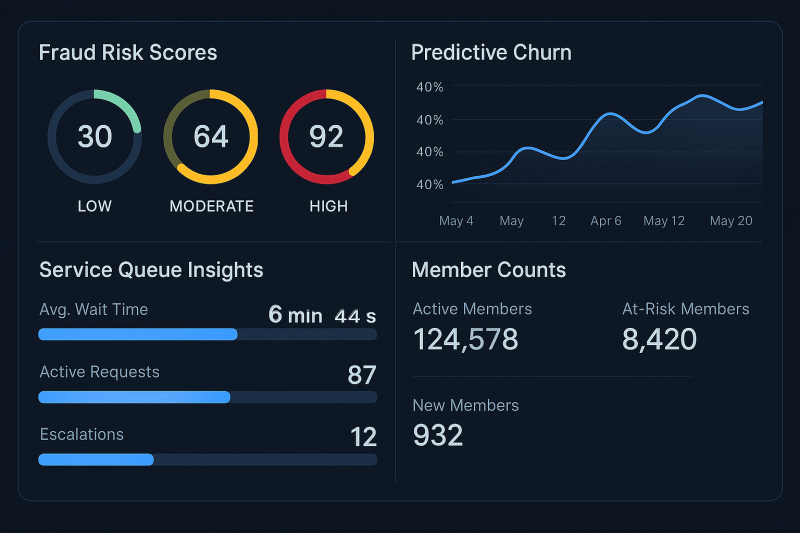
AI dashboards that surface risk, member trends and service insights turn data into action.
Roadmap: Evaluate, Pilot & Scale in Your Institution
- Audit your current state: Inventory all systems (branches, cloud, endpoints, vendors), map data flows, identify regulatory/compliance gaps (PIPA, PIPEDA, PCI, AML) and run a baseline risk/IT maturity assessment.
- Secure the foundation: Implement identity controls (MFA, least-privilege), deploy EDR, ensure backups are tested and immutable, establish vendor risk program, segment networks.
- Modernize infrastructure & integrate systems: Replace high-risk legacy systems, build API layer, adopt SaaS where suitable, centralise logging & analytics, prepare data architecture for AI/ML.
- Pilot AI use-cases: Choose one high-value, low-risk application (fraud detection, chat-bot for member service, anomaly detection). Define KPIs (cost-savings, risk reduction, engagement lift), governance & human oversight. Monitor results for 90 days.
- Govern & scale: Create AI governance board (IT, risk, compliance, business). Review vendor frameworks, model bias, audit logs. Expand successful pilots to broader use-cases, integrate into operations and value-chain.
- Continuous improvement & reporting: Set quarterly KPIs (uptime, incident rate, mean time to recover, fraud reduction %, AI pilot ROI), present to senior leadership/board, update roadmap annually.
Actionable Checklist: 18 Steps for BC Financial Institutions
- Enable MFA & conditional access for all internal, branch and vendor access.
- Encrypt all endpoints (laptops, mobile, branch devices); deploy MDM or EMM.
- Deploy EDR across all devices; restrict legacy protocols and unused services.
- Segment networks: branch, corporate, vendor, guest; restrict lateral movement.
- Test backups quarterly; ensure off-site/immutable storage; document RTO/RPO.
- Maintain vendor inventory; review security posture and contracts annually.
- Create incident response plan: ransomware, BEC, vendor breach; run tabletop exercise annually.
- Deploy continuous monitoring & alerting for network, transactions, admin activity.
- Integrate core system ↔ CRM/analytics to eliminate silos and manual reconciliation.
- Roll out first AI pilot (fraud detection or member/chatbot); measure outcomes.
- Train staff/board on cybersecurity, AI risks, phishing awareness; include vendors.
- Establish AI governance: human-in-loop, audit trails, bias mitigation, vendor review.
- Define KPIs for IT, security, AI: e.g., downtime %, incident time to resolution, fraud % reduction, cost per transaction.
- Ensure compliance with PIPA (BC), PIPEDA (Canada), PCI DSS (if applicable) and branch-specific regulations; document readiness.
- Replace high-risk legacy systems or isolate them until sunset date decided.
- Plan connectivity redundancy for branches/remote advisors: dual WAN, LTE/5G failover, SD-WAN where applicable.
- Review service-provider SLAs: cloud, data centre, vendor; ensure they align with your business continuity and regulatory requirements.
- Schedule annual technology roadmap review aligned with finance strategy, business objectives and compliance calendar.
Next Steps
If you’re leading a financial institution in British Columbia—whether a credit union, community bank, fintech, or wealth-management firm—then your technology strategy needs to align with your business strategy. With a robust managed IT approach, layered cybersecurity, integrated systems and AI that’s responsibly deployed, you can support growth, compliance, customer trust and resilience.
Book your free BC Financial Institution IT & Cybersecurity Assessment and start building the roadmap that fits your strategy, risk profile and budgets.
References
- MIS.tech: The Crucial Role of IT Service Management in Finance
- Google Cloud: AI in Banking — Automation, Risk, Personalisation
- EY: How Artificial Intelligence Is Reshaping Finance
- DecypherTech: Advantages of Managed IT for Financial Services
- U.S. Treasury Report: Managing AI-Specific Cybersecurity Risks in Financial Services
Frequently Asked Questions
What is Managed IT for a financial institution?
Managed IT means outsourcing or partnering with a specialist to manage your IT infrastructure (networks, endpoints, cloud, branch connectivity, remote access) with proactive monitoring, patching, disaster recovery and strategic advisory—all aligned to your business and regulatory requirements.
Why do financial institutions need stronger cybersecurity than most industries?
Because financial institutions handle highly sensitive personal, account and transaction data; operate branches and remote access; are regulated; and are targeted by sophisticated cyber-threat actors including deepfakes, AI-powered fraud and third-party vendor attacks.
How can AI help a bank or credit union without increasing risk?
Start with a well-defined pilot (fraud detection, chatbot, risk scoring), ensure human oversight, auditability and bias controls, integrate it into your existing systems and governance framework. Treat AI as augmentation—not full automation—and build from there.
What’s the best first step for upgrading our fintech/financial services IT stack?
Conduct a technology and security audit: map your systems, connectivity, vendor dependencies, regulatory gaps, device posture, backups and incident response. Use that baseline to prioritize identity controls (MFA), EDR, network segmentation and vendor risk — then proceed from there.


