

Building a Strong Foundation: Managed IT, Cybersecurity & AI for the Construction Industry
Executive Summary: Why IT Now Matters to Construction
The construction industry is one of the most operationally complex environments in business today. Between field crews, engineers, project managers, vendors, and clients, every decision depends on real-time data and collaboration. Yet, many firms still rely on outdated infrastructure or piecemeal systems — exposing them to inefficiencies, downtime, and security risks.
In 2025 and beyond, Managed IT, Cybersecurity, and AI Integration are no longer optional for construction firms — they are competitive advantages. These technologies improve uptime, protect critical project data, and help construction leaders make faster, more accurate decisions on-site and off.
- Reduce downtime through proactive IT monitoring and redundancy.
- Protect blueprints and project files from ransomware and data loss.
- Integrate field, fleet, and financial systems for operational efficiency.
- Use AI to predict equipment failures, improve safety, and optimize scheduling.
Let’s explore how these elements come together to future-proof the construction industry.
What Managed IT Looks Like for Construction Firms
Managed IT Services provide construction companies with end-to-end management of their IT environment — from networks to cloud storage to job site support. For construction, it’s not about one-size-fits-all IT. It’s about rugged, mobile, and resilient systems that perform anywhere — from high-rises to remote job sites.
Core Managed IT Components
- 24/7 Monitoring & Maintenance: Remote Management & Monitoring (RMM) tools watch over routers, VPNs, and endpoints, identifying issues before they cause downtime.
- Patch Management: Regular updates for field laptops, servers, and project software (AutoCAD, Revit, etc.) to close vulnerabilities and improve performance.
- Helpdesk & Field Support: Centralized helpdesk with escalation paths for on-site tech dispatches ensures minimal delays during active projects.
- vCIO Strategy: A virtual CIO helps align IT strategy with business objectives — guiding investments in cloud migration, compliance, and digital transformation.
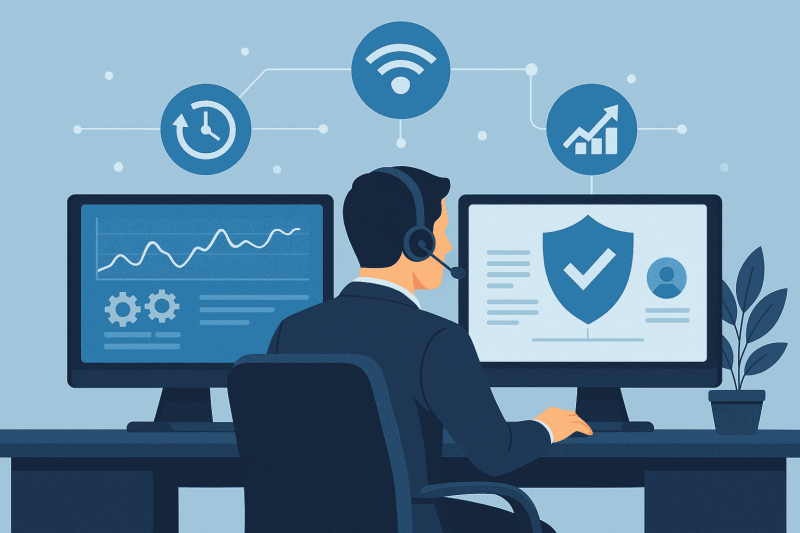
A managed IT approach provides continuous monitoring, rapid response, and strategic planning.
Onsite vs. Remote vs. Hybrid IT Support
Construction firms often need both remote and on-site assistance. A hybrid model ensures field crews receive quick remote fixes for software issues while critical network or hardware failures trigger on-site dispatches. The result? Less downtime, more productivity.
SLAs and ROI
Managed IT is a predictable cost model. Instead of reactive “break/fix” spending, firms pay a flat monthly fee that covers maintenance, monitoring, and support. The ROI comes from reduced downtime — even saving one hour per week per crew can translate to thousands in productivity gains.
Everyday IT Challenges Construction Firms Face
Construction sites are dynamic, high-pressure environments — and that creates unique IT challenges. The following issues are common across the industry:
Connectivity & Remote Site Networks
Job sites often operate in areas with limited or unstable connectivity. Without reliable internet, teams can’t sync drawings, update schedules, or communicate effectively. Solutions like 5G routers, LTE failover, and satellite links (Cradlepoint, Peplink, Starlink) ensure teams stay connected no matter where they build.
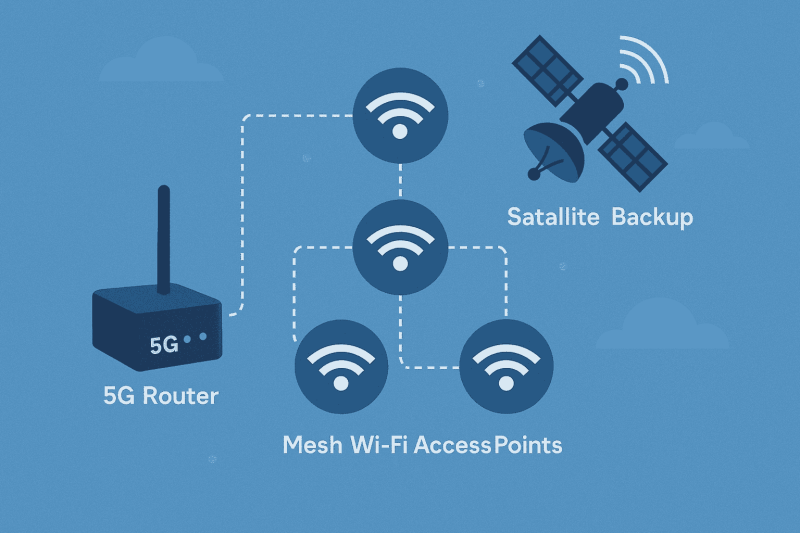
Redundant network design reduces downtime on remote sites.
Device & Endpoint Management
Field devices — tablets, laptops, rugged smartphones — are easily lost or damaged. Mobile Device Management (MDM) systems like Microsoft Intune or Kandji enforce encryption, app policies, and location tracking, reducing data exposure risks.
Software Fragmentation & Document Control
Projects often span multiple tools: Procore for project management, Autodesk for design, and Excel for budgeting. Without integrations, teams waste hours reconciling versions. Implementing a unified document control process through platforms like SharePoint or Autodesk Docs ensures every stakeholder works from the same blueprint.
Cybersecurity in Construction: Protecting Blueprints and Beyond
Construction firms are now prime targets for cybercriminals. In 2024, global cybersecurity reports found ransomware attacks on infrastructure and construction companies rose by over 68%.(ReliaQuest)
Common Attack Vectors
- Phishing & Social Engineering: Employees receive spoofed emails from “vendors” containing malware-laden attachments.
- Ransomware: Blueprints, CAD drawings, and contracts are encrypted — halting operations until payment is made.
- Vendor Access Risks: Subcontractors using unsecured Wi-Fi or devices can compromise your network.
Practical Defenses
- Identity Security: Implement Multi-Factor Authentication (MFA) and conditional access rules to block unauthorized logins.
- Network Segmentation: Separate guest Wi-Fi, office, and field networks to contain breaches.
- Endpoint Detection & Response (EDR): Tools like CrowdStrike or Microsoft Defender monitor for abnormal activity.
- Immutable Backups: Systems like Datto or Veeam ensure recovery from ransomware attacks within hours, not days.
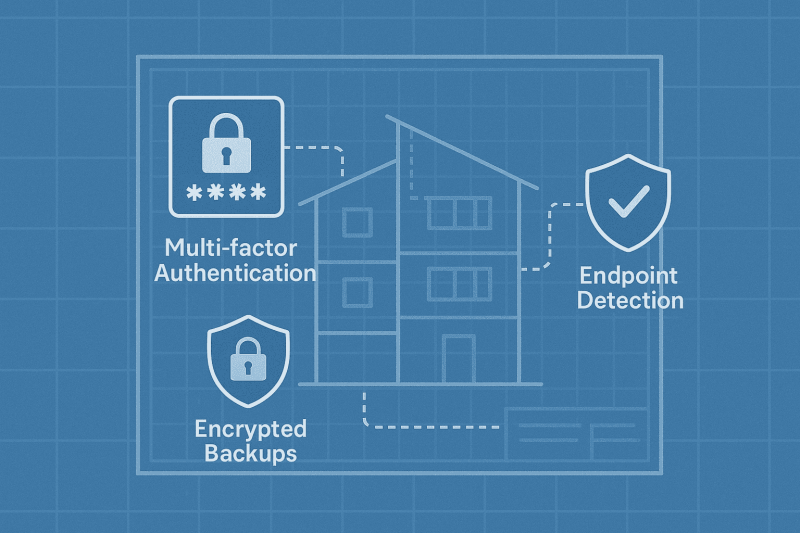
Protecting project files and blueprints should be part of every firm’s cybersecurity plan.
Incident Response Checklist
- Detect and isolate the affected system.
- Engage your IT provider’s Incident Response team.
- Restore clean backups.
- Update credentials and access policies.
- Conduct a post-mortem to prevent recurrence.
Technology Integration: Making Systems Talk to Each Other
Construction workflows rely on a blend of project management, ERP, fleet, and document tools. Integrating these systems can dramatically improve efficiency, reduce errors, and create a single source of truth across your organization.
Project Management & Document Control
Procore and Autodesk Construction Cloud remain industry standards, but their true power emerges when integrated with cloud storage (e.g., SharePoint, OneDrive). Unified authentication (Azure AD or Okta) ensures secure, seamless access for teams and subcontractors.
Fleet, Telematics & IoT Integration
Construction fleets rely on IoT sensors to track equipment utilization, maintenance, and fuel usage. Platforms like Samsara and Trimble connect directly to your Managed IT infrastructure, enabling predictive alerts, real-time GPS, and reporting dashboards.
Accounting & ERP Tie-ins
Integrating accounting tools such as Sage 300 Construction or Viewpoint with your operational systems streamlines billing and procurement. With proper VPN and API security, finance teams gain real-time visibility into costs without risking data breaches.
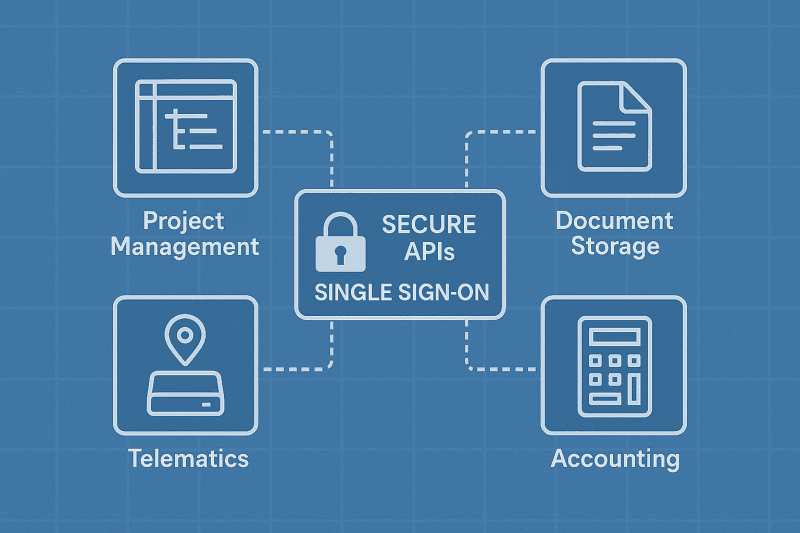
A secure integration layer keeps all your construction systems synchronized.
AI Integration in Construction: From Blueprints to Intelligence
Artificial Intelligence (AI) is transforming how construction companies operate — from safety monitoring to predictive maintenance and schedule optimization. The key isn’t “AI for the sake of AI,” but targeted use cases that improve daily operations and profitability.
Predictive Maintenance & Equipment Lifecycle
Sensors embedded in heavy machinery collect vibration, temperature, and usage data. Machine learning models analyze this data to predict component failures before they happen — saving thousands in unplanned downtime.
Computer Vision for Safety & Progress Tracking
Platforms like OpenSpace and DroneDeploy use AI-driven image recognition to identify hazards, track progress, and ensure compliance. AI can flag workers without PPE or detect unsafe scaffolding in real time.
Document Intelligence & RFI Automation
Natural Language Processing (NLP) models can read and categorize thousands of RFIs, change orders, and inspection documents — auto-filling metadata and routing them to the right team members instantly.
Low-Risk AI Pilots
Construction firms can start small: predictive maintenance, safety analytics, or scheduling optimization. Once data pipelines are stable, AI can be expanded to material forecasting, risk modeling, and real-time project optimization.
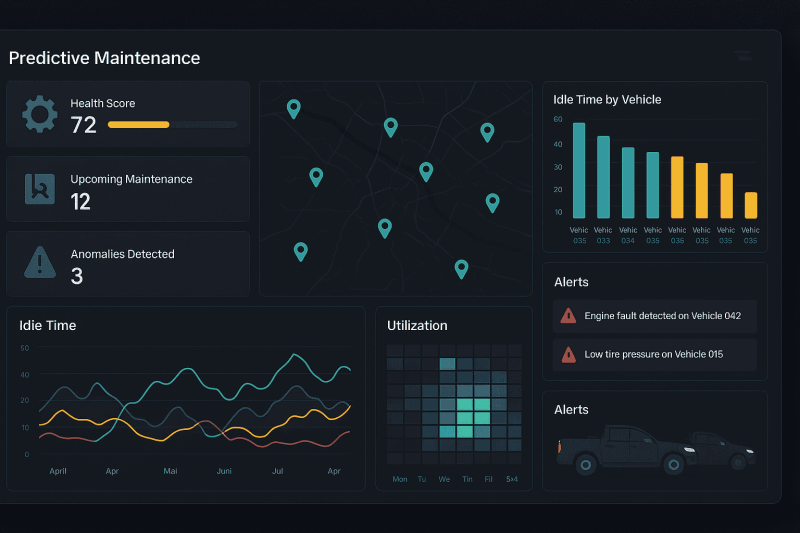
AI dashboards translate sensor data into actionable maintenance and fleet decisions.
Roadmap: How to Evaluate, Pilot & Scale Technology
- Assess your current infrastructure: Audit networks, backups, and software licenses.
- Implement cybersecurity basics: MFA, EDR, immutable backups.
- Upgrade connectivity: Deploy redundant internet solutions for job sites.
- Integrate systems: Connect project management, ERP, and fleet tools.
- Pilot AI use cases: Start with measurable outcomes like maintenance alerts or safety compliance.
- Train your teams: Conduct ongoing IT and cybersecurity awareness sessions.
Actionable Checklist: 15 Steps for IT Success in Construction
- Enable MFA across all systems within 7 days.
- Run a phishing simulation for all staff this month.
- Implement mobile device encryption policies.
- Upgrade job site routers to 5G/LTE redundancy.
- Centralize blueprints in secure cloud storage.
- Enforce version control for all documents.
- Schedule weekly automated backups.
- Deploy an EDR solution to all endpoints.
- Review firewall and VPN configurations quarterly.
- Integrate ERP with project management software.
- Run an AI pilot for predictive maintenance.
- Train staff on cyber hygiene quarterly.
- Maintain an incident response playbook.
- Audit vendor access and permissions.
- Schedule annual technology roadmap reviews.
Next Steps
Your digital foundation is as critical as the physical one you build. With a robust Managed IT strategy, strong cybersecurity posture, and practical AI integrations, your construction firm can achieve greater safety, predictability, and profit margins.
Get your free Construction IT & Cybersecurity Assessment and start building a smarter, more secure future for your projects.
References
- ReliaQuest: Construction Cybersecurity Threats
- Reuters: Ransomware trends in critical infrastructure
- Sygnia: 2024 Ransomware Analysis
- Oracle: AI for Predictive Maintenance in Construction
- Construction Today: AI and Jobsite Safety
- Procore: 2024 Financial and Market Report
Frequently Asked Questions
What is Managed IT for construction companies?
Managed IT provides construction firms with ongoing monitoring, maintenance, and support for all technology systems — ensuring uptime, security, and scalability.
Why is construction targeted by ransomware?
Attackers know construction companies rely heavily on digital blueprints and scheduling tools. Disrupting these systems forces companies to pay ransoms to resume operations.
How does AI improve construction site safety?
AI-powered cameras and analytics platforms can automatically detect safety violations, such as missing PPE or fall hazards, reducing accidents and compliance risks.
What’s the best first step for implementing cybersecurity?
Start with the basics: enable MFA, back up critical data, and train staff. Then, add advanced protections like EDR, SIEM, and incident response plans.


