
Building Trust & Efficiency: Managed IT, Cybersecurity & AI for BC Credit Unions & Not-for-Profits
For BC credit unions and not-for-profits, secure, reliable, and integrated IT is mission-critical.
Executive Summary: Why IT Now Matters to BC Credit Unions & Not-for-Profits
Member and donor trust sits at the heart of every credit union and not-for-profit in British Columbia. That trust relies on resilient systems, strong cybersecurity, compliance with provincial and federal privacy laws, and the ability to deliver seamless digital services. In 2025 and beyond, Managed IT, Cybersecurity, Technology Integration, and AI are no longer “nice to have”—they’re foundational to mission delivery, regulatory readiness, and operational excellence.
- Reliability & Uptime: Proactive monitoring, modern networks, and cloud redundancy protect service continuity across branches and remote teams.
- Security & Compliance: A layered security model aligned to PIPA (BC), PIPEDA (Canada), and industry best practices protects member/donor data and institutional reputation.
- Integration: Connecting core banking or donor systems with CRM, analytics, and collaboration tools eliminates silos and manual work.
- AI Enablement: AI improves fraud detection, member/donor engagement, underwriting, forecasting, and back-office efficiency—without sacrificing the human touch.
BC & Canadian Regulatory Context (What Actually Applies to You)
Operating in BC means aligning technology and security to a combination of provincial and federal frameworks. While exact applicability depends on your charter and operations, the following often come into play:
- PIPA (BC’s Personal Information Protection Act): Governs how private-sector organisations in BC collect, use, and disclose personal information. Emphasises accountability, consent, safeguarding, and access/correction rights.
- PIPEDA (Federal): Applies to many private-sector organisations in Canada for commercial activities; establishes principles like consent, limiting collection, accuracy, safeguards, openness, and individual access.
- BCFSA Oversight (Credit Unions): BC credit unions are regulated by the BC Financial Services Authority (BCFSA). Expect expectations around operational risk, third-party/vendor risk, cybersecurity, and business continuity.
- Anti-Money Laundering (as applicable): Processes and controls to meet AML/ATF obligations, including KYC and transaction monitoring (often coordinated with your core and compliance tooling).
Practical takeaway: Your IT program should map its controls to these requirements—e.g., formal policies, access controls, encryption, vendor due diligence, incident response, and ongoing training—then prove it with logs, reviews, and board-level reporting.
What Managed IT Looks Like for Credit Unions & Not-for-Profits
Managed IT Services provide end-to-end support—from the branch to the cloud—so your teams can focus on members and mission, not on patching laptops or troubleshooting outages.
Core Managed IT Components
- 24/7 Monitoring & Response (RMM/SOC): Continuous visibility across endpoints, servers, firewalls, and cloud. Issues are detected early and remediated quickly.
- Patch & Vulnerability Management: Systematic OS/app updates, vulnerability scans, and prioritized remediation, with maintenance windows that fit branch hours.
- Helpdesk & On-Site Support: Friendly first-line support for staff plus escalations and on-site dispatch for network/hardware incidents.
- Backups & DR: Encrypted, immutable backups with tested recovery and documented Recovery Time/Point Objectives (RTO/RPO).
- vCIO & IT Roadmapping: Quarterly planning, budget forecasting, and KPI reporting to align technology with strategy and compliance.
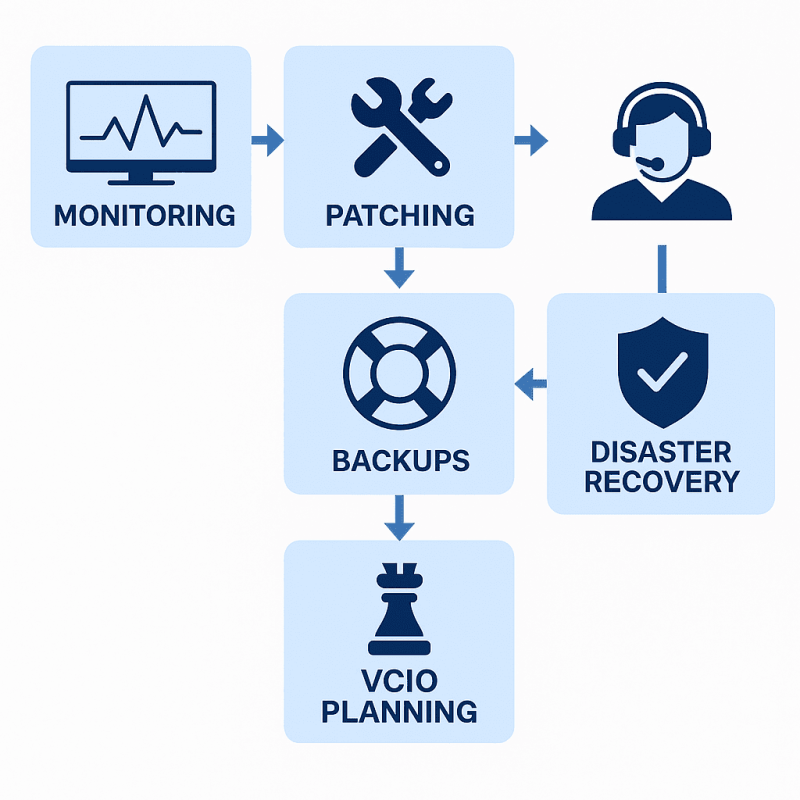
A mature managed IT program blends proactive operations with strategic planning and compliance.
Connectivity & Branch Readiness
Design for redundancy at the branch: dual WAN links (e.g., fibre + LTE/5G), QoS for critical apps, SD-WAN for smart failover, segmented Wi-Fi (staff/guest), and VPN/Zero-Trust for secure remote work.
Service Levels & Cost Predictability
Per-user or per-endpoint pricing creates predictable OPEX. The ROI shows up as fewer disruptions, faster employee support, improved audit readiness, and reduced breach risk.
Everyday IT Challenges in BC Credit Unions & NFPs
Legacy Platforms & Data Silos
Core systems, donor CRMs, accounting, and payment tools often don’t talk to each other. Teams export CSVs, re-key data, or reconcile spreadsheets—slowing service and increasing risk.
Device Sprawl & Hybrid Work
Branch, remote, and volunteer devices multiply your attack surface. Without MDM/Endpoint management (encryption, conditional access, least privilege), data exposure risk climbs.
Talent & Budget Constraints
Small internal teams juggle everything from printers to pen-tests. A co-managed model lets your staff own what they do best while a partner handles the heavy lift (monitoring, upgrades, compliance artifacts, and after-hours coverage).
Cybersecurity: Protecting Data, Reputation, and Member/Donor Trust
BC credit unions and NFPs are attractive targets because you hold sensitive personal and financial data and often rely on third-party vendors. A layered security program—aligned to CIS Controls/NIST-style practices—reduces risk and demonstrates due diligence to your board, auditors, and regulators.
Key Threats
- Phishing & Business Email Compromise (BEC): Social engineering of staff or volunteers via email/SMS/voice-spoofing.
- Ransomware & Data Exfiltration: Encrypting systems and/or stealing data to extort payment.
- Vendor/Supply-Chain Risk: Third parties with privileged access become an attack path.
- Misconfiguration & Legacy Tech: Unpatched systems, exposed services, weak MFA, or over-permissive access.
Practical Defences (Right-Sized for BC Orgs)
- Identity & Access: MFA everywhere, conditional access (block risky sign-ins), role-based permissions, and periodic access reviews.
- Endpoint Security: EDR on all endpoints; block macros by default; device encryption; USB/media controls.
- Email & Web Security: Advanced phishing protection, link rewriting/sandboxing, DMARC/SPF/DKIM, safe browsing controls.
- Network Segmentation: Separate staff, guest, vendor, and privileged admin networks; lock down East-West traffic.
- Backups & DR: Immutable backups off-domain; quarterly restore tests with documented results for audit.
- Vendor Risk Management: Maintain a vendor inventory, assess controls, collect SOC 2 / security attestations, and define breach notification in contracts.
- Security Awareness: Mandatory onboarding + quarterly micro-modules; phishing simulations; “report-phish” button and no-blame culture.
- Incident Response: Playbooks for ransomware/BEC/vendor breach; tabletop exercises; predefined communications and escalation paths.
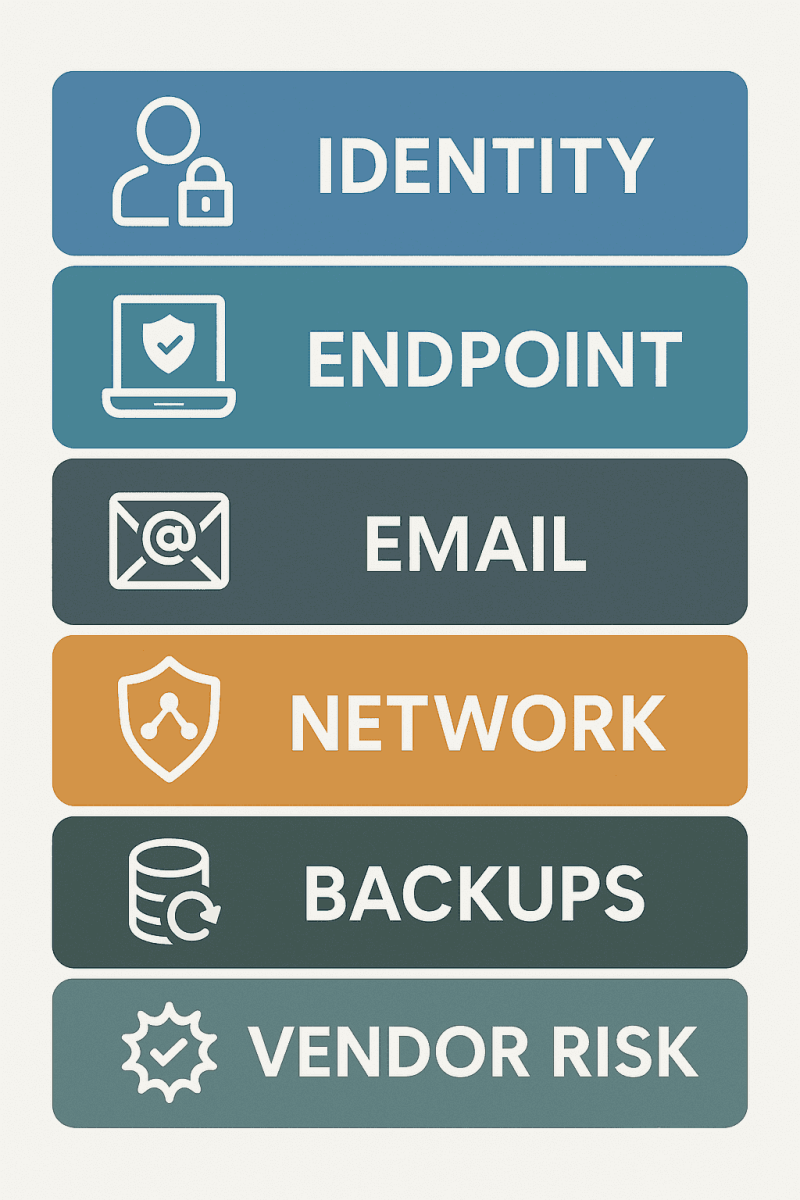
Layered controls create defence-in-depth while staying audit-ready for BC requirements.
Technology Integration: Make Systems Talk, Reduce Manual Work
Integration cuts errors and staff effort while improving member/donor experiences. Start from an API-first mindset and a small integration backlog you continuously burn down.
High-Value Integration Patterns
- Core ↔ CRM: Sync profiles, preferences, service history, and interactions to enable personalised service.
- Online & Mobile ↔ Analytics: Centralise behavioural and transactional data for insights (churn risk, campaign performance, service gaps).
- Donor Management ↔ Finance: Automate reconciliations, receipting, and grant reporting; maintain audit trails.
- Service Desk ↔ Knowledge Base: Surface policy answers in the agent view and member portal to deflect tickets.
Cloud & Hybrid Architecture
BC orgs commonly run hybrid: some workloads in Microsoft 365/Google Workspace/SaaS; others on-prem for latency or data residency. Use identity federation (e.g., Azure AD/Entra) plus Zero-Trust principles to secure access everywhere.
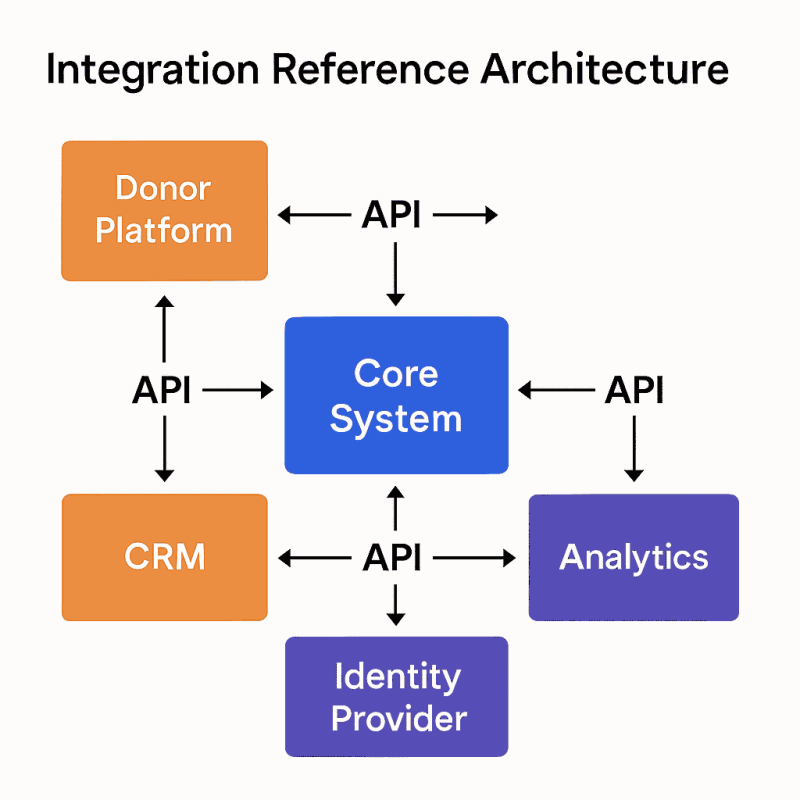
A lightweight integration layer (iPaaS/API gateway) reduces swivel-chair work and improves data quality.
AI Integration: From Insight to Action (Without Losing the Human Touch)
AI should augment your team, not replace your mission-driven culture. Begin with low-risk, high-value pilots and bake in governance (data quality, privacy, fairness, human-in-the-loop review).
Practical Use Cases for Credit Unions
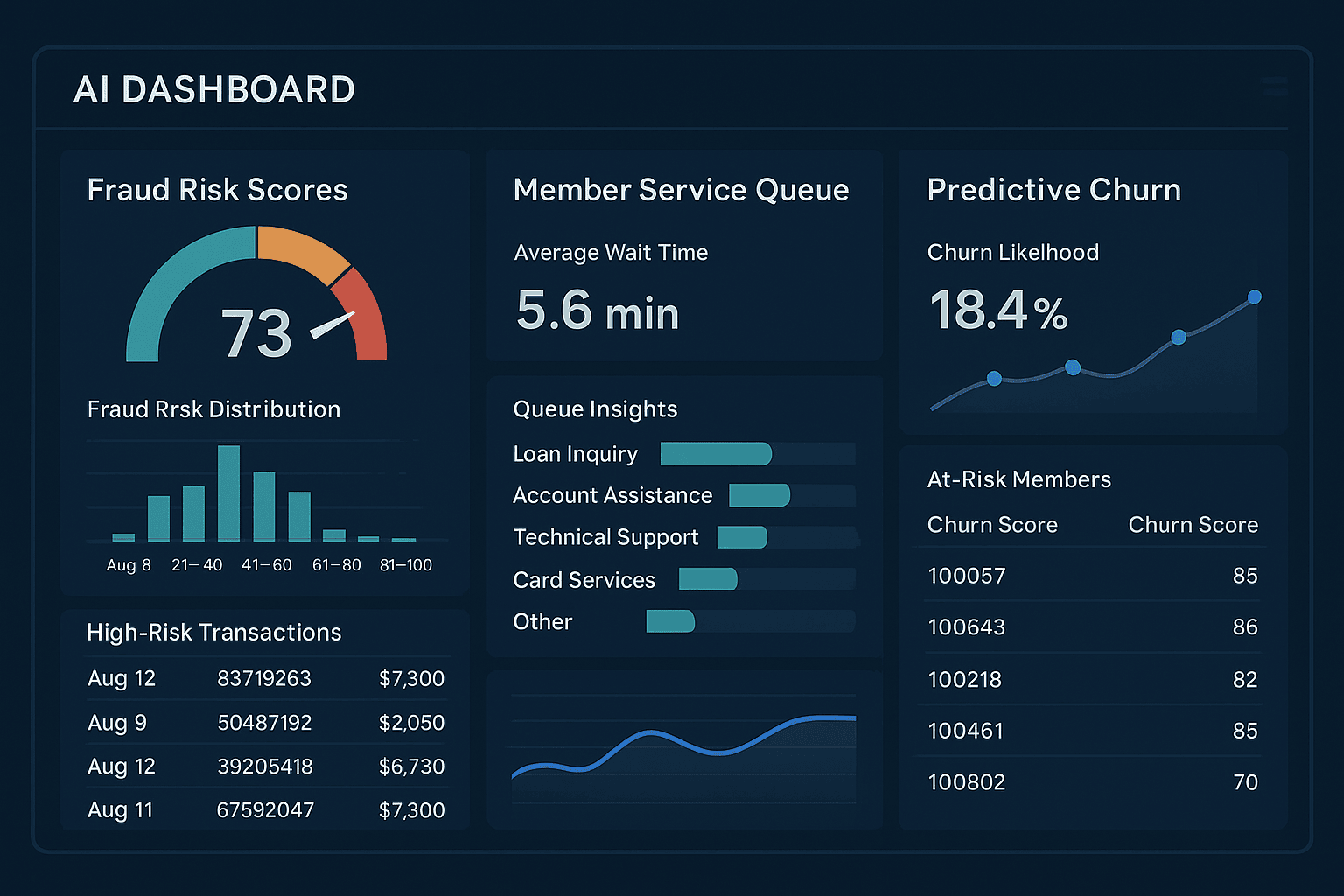
- Fraud & Anomaly Detection: Spot unusual login patterns, transaction anomalies, or mule activity earlier.
- Member Service Assistants: AI chat/voice to answer common questions, triage requests, and empower frontline staff with faster knowledge retrieval.
- Underwriting Support: Risk models that inform (not decide) lending—keep human adjudication to preserve fairness and accountability.
- Churn & Next-Best-Action: Predict attrition risk, suggest relevant offers or financial coaching pathways.
Practical Use Cases for Not-for-Profits
- Donor Segmentation & Forecasting: Predict likelihood to give, suggested ask amounts, and campaign timing.
- Grant Matching & Narrative Drafts: AI assistants surface relevant grants and generate first-draft narratives for human refinement.
- Volunteer Scheduling & Outreach: Optimise shifts, nudge reminders, and summarise impact reports.
AI Guardrails
- Document intended use, data sources, and human review points.
- Prefer explainable features over opaque black boxes for regulated decisions.
- Minimise personal data in prompts; apply privacy-by-design and data retention limits.
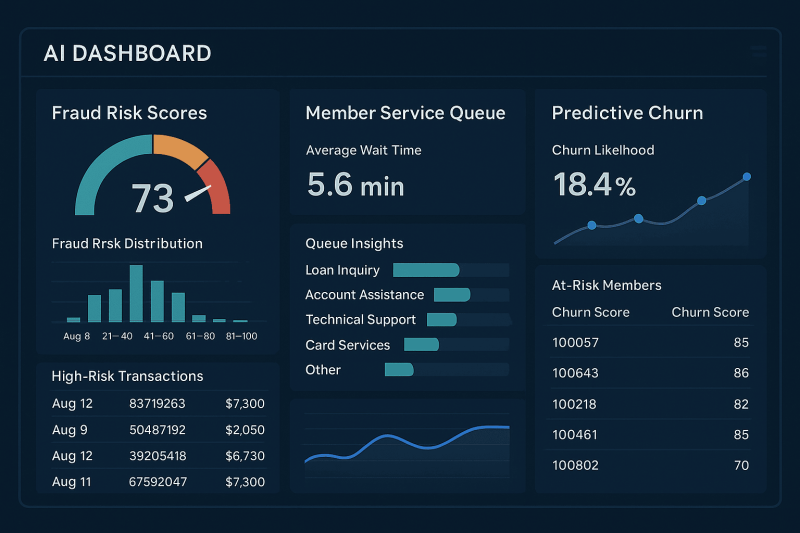
AI turns raw data into prioritised action lists—keeping humans in control.
30/60/90-Day Roadmap (BC-Ready)
Days 0–30: Stabilise & Secure
- Environment assessment (assets, risks, gaps) mapped to PIPA/PIPEDA controls.
- MFA everywhere; close high-risk firewall/identity exposures.
- Enable EDR and email security; block legacy auth; enforce device encryption.
- Backup validation and a quick DR drill; document RTO/RPO.
Days 31–60: Integrate & Document
- MDM rollout (policies for branch/remote/volunteer devices).
- Pick 1–2 small integrations (e.g., core↔CRM or donor↔finance) and complete end-to-end.
- Publish/update policies: access control, incident response, vendor management, change management.
- Security awareness training and a phishing simulation; board/leadership briefing.
Days 61–90: Pilot AI & Optimise
- Choose one AI pilot (fraud triage, member assistant, donor forecasting); define metrics and governance.
- Close medium-risk findings; plan next integration backlog (API first).
- vCIO quarterly review: KPIs, lessons learned, budget forecast, and 12-month roadmap.
KPIs & Board-Friendly Reporting
- Operational: Uptime %, mean time to resolve (MTTR), ticket volume by category, patch compliance %.
- Security: MFA coverage, EDR coverage, phishing fail rate trend, backup test success, critical vuln SLA adherence.
- Compliance: % policy coverage, vendor reviews completed, incident tabletop frequency and outcomes.
- Integration/AI: Manual hours saved, duplicate data reductions, time-to-serve improvements, AI pilot ROI.
Actionable Checklist: 18 Steps for BC Credit Unions & NFPs
- Implement MFA + conditional access for all users (including vendors).
- Encrypt all endpoints; enforce MDM with baseline policies.
- Deploy EDR and email protection; disable legacy protocols.
- Document and test backups/DR; store immutable backups off-domain.
- Segment networks; separate admin, staff, guest, and vendor access.
- Create a vendor inventory; review critical vendors annually.
- Update access control and incident response policies; run a tabletop.
- Roll out quarterly security awareness and phishing simulations.
- Map controls to PIPA/PIPEDA; retain evidence for audits.
- Establish change management and logging/monitoring standards.
- Prioritise two integrations per quarter; kill manual exports where possible.
- Stand up a data catalog and basic privacy impact assessments (PIAs) for new systems.
- Select one AI pilot with clear guardrails and human oversight.
- Instrument KPIs and share a quarterly board report.
- Harden identity for privileged accounts (admin break-glass, PAM).
- Adopt passwordless or phishing-resistant MFA where feasible.
- Review Wi-Fi posture at branches; rotate PSKs and disable WPS.
- Schedule an annual roadmap review with budget alignment.
Next Steps
Your members and donors count on you for stewardship and service. With a strong Managed IT foundation, layered cybersecurity, smart integrations, and pragmatic AI, your BC organisation can strengthen trust, improve efficiency, and scale impact.
Book a free BC Credit Union/NFP IT & Cybersecurity Assessment to get a prioritised roadmap tailored to your institution.
Internal Link Placeholders
- Managed IT Services
- Cybersecurity & Compliance
- AI & Automation
- About Happier IT
- Contact / Assessment
Frequently Asked Questions
How do BC privacy laws affect our IT program?
Design controls to meet PIPA (BC) and, where applicable, PIPEDA (federal). That means formal policies, consent handling, secure storage and transmission, role-based access, vendor due diligence, and auditable evidence.
We have a small team—can we still meet best practices?
Yes. A co-managed model offloads monitoring, patching, and after-hours response while your team keeps institutional knowledge and high-touch projects.
What is the safest way to start with AI?
Pick a low-risk pilot (fraud triage, member/donor Q&A assistant). Define KPIs, data boundaries, human oversight, and review outputs regularly.
How do we prove compliance to our board and auditors?
Maintain a control map, policy library, training records, vendor assessments, incident playbooks, restore tests, and KPI dashboards. Review quarterly at the board level.


